If you’re 50 or older and behind on super, you can still catch up. Three options are carry-forward (catch-up) contributions, a downsizer contribution after selling your home, and making sure super is dealt with properly if you separate.
For 2026-27 you can contribute up to $32,500 pre-tax, plus any unused cap from the past five years if your balance is under $500,000.
Key Takeaways
- ·The typical woman aged 50 to 54 has about $58,000 less super than the typical man.
- ·Women are already contributing extra at a higher rate than men, so the effort is there.
- ·Each strategy has eligibility rules and Age Pension effects, so get advice before you act.
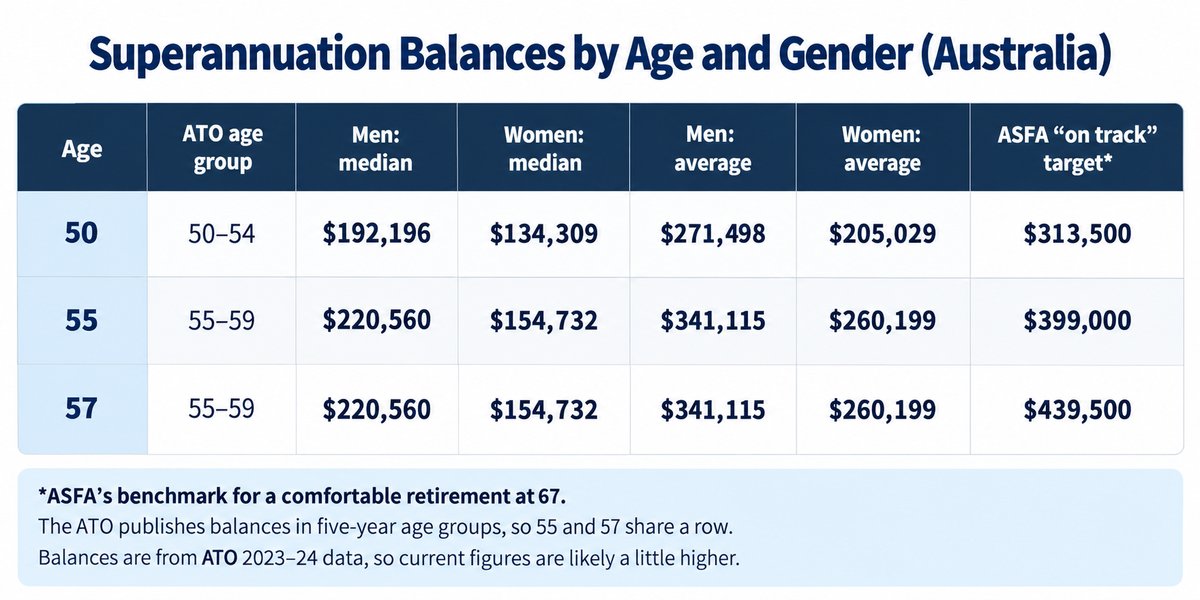
Against the benchmark, a woman with the median balance at 55 is about $244,000 short of $399,000, and a man about $178,000. More recent fund data shows the same pattern. Aware Super’s August 2026 member data found a median of $181,935 for women aged 45 to 59, compared with $240,060 for men.
Why Do Women Have Less Super Than Men?
Women typically have lower lifetime earnings, more part-time and casual work, and more time out of the workforce for caring. Life events can leave women with up to $95,000 less by retirement, according to analysis reported in June 2026. That same analysis found the gap for people aged 60 to 64 is now 26%, up from 20.5% in 2016-17.
It also shows how hard many women are trying. Women make extra personal contributions at a higher rate than men (11.6% versus 10.0%).
Is It Too Late to Catch Up at 50?
No. Women are less confident about retirement than men: 62% worry about not having enough, compared with 48% of men. But advice helps. In Colonial First State’s 2026 survey, 77% of people who’d received financial advice felt prepared, versus 45% who hadn’t.
Three Ways to Catch Up
1. How do carry-forward (catch-up) super contributions work?
The pre-tax (concessional) cap is $32,500 for 2026-27. If your total super balance was under $500,000 on the previous 30 June, you can also use unused cap from up to five previous years. The oldest unused amounts are used first.
For example, if you have $60,000 unused, you could contribute up to $92,500 this year. The ATO applies the carry-forward automatically once you exceed the general cap, and you can see your available amounts in ATO online services (Super, then Information, then Carry forward concessional contributions).
These contributions are generally taxed at 15% inside super, and personal contributions may be tax deductible. Contributions generally need to reach your fund by 30 June to count for that year.
2. What is a downsizer contribution and who can use it?
If you’re 55 or over, you can put up to $300,000 of your home sale proceeds into super. Couples can contribute up to $600,000 combined. To be eligible:
- ·You or your spouse must have owned the home for at least 10 years.
- ·You can’t have made a downsizer contribution before.
- ·You must give your fund the downsizer form before or when you contribute.
- ·You generally need to contribute within 90 days of receiving the proceeds.
It doesn’t count towards your contribution caps. It does count in the Age Pension assets and income tests, so get advice before you sell. About 123,000 people have used the scheme since 2018, contributing $31.8 billion.
3. What happens to my super in a divorce or separation?
Super is treated as property under the Family Law Act. It can be split by a formal agreement or court order, and it isn’t automatically split 50/50. The court considers contributions during the relationship, each person’s future capacity and any dependants.
Married couples generally have 12 months from the date of divorce to apply for a splitting order. A flagging order can stop the fund paying out until the matter is resolved, and if you’re eligible, the court can ask the ATO to disclose your former partner’s super details. You’ll need legal advice, and it helps to have your accountant and planner involved early.
What Else Can I Do?
- ·Check your contributions are arriving. Since 1 July 2026, employers must get super to your fund within 7 business days of payday.
- ·Consider after-tax contributions. The non-concessional cap is $130,000 for 2026-27, if your balance allows.
How Can Cashflow Financial Help?
Our accountants can work out your unused concessional cap, check your total super balance, time contributions to maximise your deduction, and advise on the tax of selling your home.
Our financial planners can model your retirement income, show how contributions and a home sale would affect the Age Pension, and help plan the financial side of a separation.
Book a time to talk with our team today. We have offices in Sutherland and Wollongong.
Frequently Asked Questions
What is a good super balance at 50 in Australia?
ASFA’s benchmark for being on track for a comfortable retirement at 67 is about $313,500 at age 50. The typical balance at 50 to 54 is $192,196 for men and $134,309 for women, so many people have ground to make up.
How much extra can I put into super in 2026-27?
The general pre-tax cap is $32,500. If you’re eligible, you can add unused cap from up to five previous years. For example, $60,000 unused plus $32,500 allows up to $92,500.
Does a downsizer contribution affect the Age Pension?
Yes. It doesn’t count towards your contribution caps, but it is included in the Age Pension assets and income tests, so get advice before you sell.
How long do I have to split super after a divorce?
Married couples generally have 12 months from the date of divorce to apply for a super splitting order, so seek legal and financial advice early.